

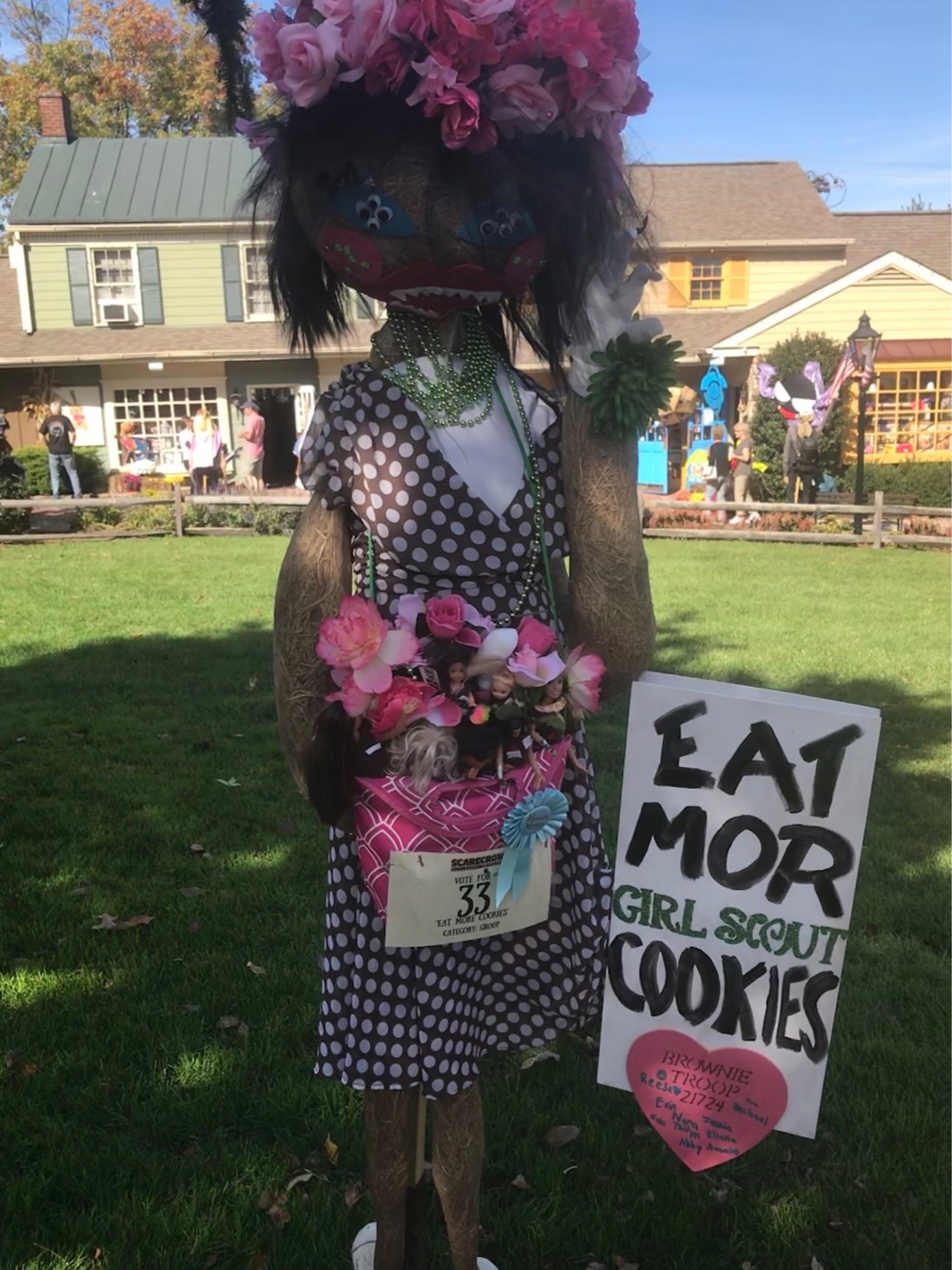
There are two major things I was tremendously fascinated with living in the USA: scarecrow festivals and turkeys.
There is something absolutely magnetic in a hand-made scarecrow: they are out of the ordinary ideas embodied in physical matter. Every single one of them is unique. Regarding a turkey-talk, I am planning to write a post about these beautiful birds closer to Thanksgiving.
Anyway, about a year go my family went to Peddlers Village in Lahaska, Pennsylvania. It was a warm sunny day so we decided to stroll through the boutiques and vote for the most impressive scarecrow in their annual Scarecrow Festival/Competition. I loved the scarecrow called Pablo Pumpkinzo ( it’s an allusion to Pablo Picasso)—it was a creative idea wrapped up in a good artwork. Witty and charming—that’s how I saw it. Sadly, the Pablo Pumpkinzo scarecrow didn’t get the First Prize but, I have no doubts, that the Spanish jokester artist would reward its’ authors creativity if he had a chance.

Admiring the rows of the original “bird frightening tools”, I wondered where these cute strawmen came from.
It turned out that the homeland of a scarecrow is…Egypt. On the banks of the River Nile, fishermen started wrapping a wooden log with a fishing net in order to protect the wheat fields from quails. Such a primitive design actually worked—the wheat calmly grew, and the net served as an easy tool to catch hungry quails. As a result, the Ancient Egyptians killed two birds with one stone.
Later, the Greeks followed that very same path. They also made wooden scarecrows, looking like Priapus—a minor rustic fertility god, protector of livestock, fruit plants and gardens. According to the Greek mythology he was the son of the fertility god Dionysus and the beauty goddess Aphrodite. These imitations of gods were painted in purple. They held a sickle symbolizing good harvest and a stick intimidating the birds.
The Ancient Romans shamelessly stole the idea of scarecrowing from the Greeks and introduced them to rest of Europe during numerous military campaigns.
Although the Japanese are the ones who can not be suspected of stealing a scarecrow idea. Being on the other side of the world, they invented their variant of a scarecrow to protect rice fields. And it happened almost simultaneously. “Kakashi” (“scarecrow” in Japanese), was a real breakthrough in the art of creating “bird field fighters”. The Japanese dressed their scarecrows in a coat and a round straw hat, adorning them with bows and arrows for a scary look. By the way, Kakashi Hatake is a fictional character in the Naruto manga and anime series created by Masashi Kishimoto. He is depicted just like a real man – 181 cm in height, weighing 67.5 kg, “born” on October 15.
But let’s return to the historical evolution of the scarecrow effect. In Medieval Britain, great minds went even further and decided to use boys and girls as field guards. Kids were strolling through the fields and, if a bird approached the crops, they began to wave their hands and throw stones at the perpetrators. Apparently, children were not too fond of such a daily activity, thus, the occupation of “a bird hustler” gradually disappeared. So farmers had nothing left to do than to master the art of making a stuffed scarecrow: a sack of hay was its body, a pumpkin represented its head and a metal spin was used as a scarecrow’s spine.
Alongside the discovery of America, the popularity of scarecrows grew considerably. The New World was happy to adopt the new way of protecting their crops. “Straw Twins of People” won not only the farmers’ hearts but also those of writers and readers.
Let’s just think of the Scarecrow from the immortal masterpiece “The Wizard of Oz” by Lyman Frank Baum. The Scarecrow reveals that he lacks a brain and desires above all else to have one. Throughout the course of the novel, he demonstrates that he already has the brains he seeks and is later recognized as “the wisest man in all of Oz.” It was the Scarecrow who comes to the witty conclusion that “…some people without brains do an awful lot of talking… don’t they?”
Centuries later, scarecrows still do not lose their popularity. There are regular “bird field fighters” festivals in the United States, Canada, and the UK. Children love to compete in creating the most outstanding scarecrow. I wonder what the future holds for them…
By the way, it was the Scarecrow who Dorothy bonded the most with. Saying her goodbyes she confessed: “ I think I’ll miss you most of all”.
And in my turn, I can confess that I will miss the Annual Scarecrow Festival at Peddlers Village too. Fortunately, there are only 365 days left to wait until the next colorful event.
 Ukrainian in Philly